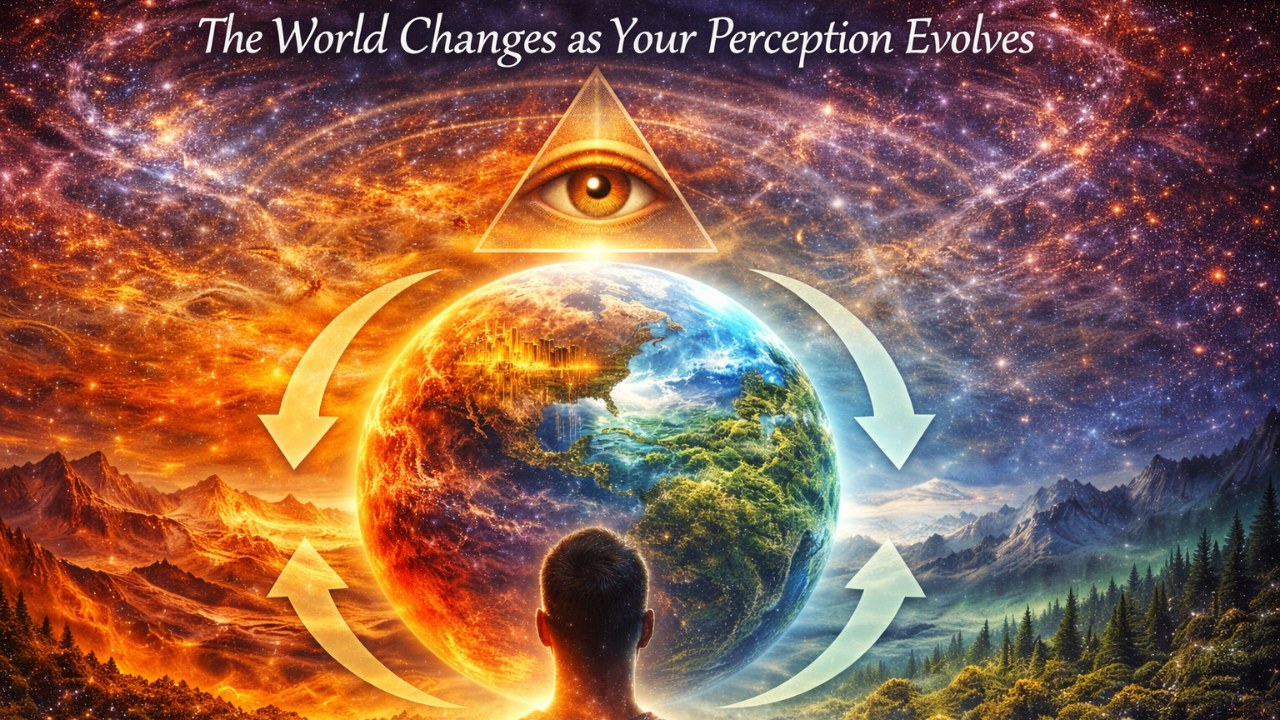
The World Changes as Your Perception Evolves
Feb 06, 2026The World Changes as Your Perception Evolves
The world rarely changes the way we expect.
It doesn’t announce itself.
It doesn’t rearrange on command.
And it almost never shifts because we try harder.
What changes first is quieter.
Perception.
Before circumstances move, something inside you loosens. A familiar interpretation releases its grip. What once felt obvious begins to feel provisional. What once felt fixed starts to breathe.
You may not notice this at first.
Most people don’t.
They wait for evidence—an external sign that life has turned a corner. But perception doesn’t work that way. It turns the corner first. Reality follows later.
The unseen gate
Every experience passes through an internal gate before it becomes “the world.”
That gate is made of memory, expectation, identity, and unspoken agreements about how things are supposed to work. It filters what you notice, what you dismiss, and what you react to without question.
Nothing reaches you unshaped.
This isn’t a flaw.
It’s how orientation works.
But over time, that gate can harden. It stops updating. You keep seeing today through yesterday’s lens—responding to situations that no longer exist, protecting against threats that have already passed.
When perception evolves, that gate reopens.
Not dramatically.
Incrementally.
Why change feels slow
People often say the world is resistant to change.
What they usually mean is that their perception hasn’t caught up with what’s already possible.
The nervous system is conservative. It prefers the known—even when the known is limiting. It will reinterpret new information to preserve old coherence unless something interrupts the pattern.
That interruption doesn’t come from force.
It comes from awareness.
The moment you truly see something differently—not intellectually, but somatically—the system recalibrates. Old reactions lose their fuel. New responses emerge without effort.
From the outside, it looks like life shifted.
From the inside, it feels like relief.
Seeing is not passive
Perception is not a mirror.
It’s a participation.
What you consistently notice gains weight.
What you stop reinforcing begins to dissolve.
This isn’t about optimism or reframing. It’s about attention. About what you allow to organize your energy, your decisions, your sense of what matters.
Seeing differently doesn’t require belief.
It requires presence.
And presence changes everything it touches.
The quiet reordering
When perception evolves, reality reorganizes around it.
Conversations change tone.
Choices feel cleaner.
Certain struggles simply lose relevance.
Not because they were solved—but because they were outgrown.
This is often mistaken for avoidance. It isn’t. It’s maturity. The ability to stop feeding what no longer needs to be metabolized.
You don’t argue your way into a new world.
You inhabit it by seeing from a different place.
A closing orientation
If the world feels stuck, overwhelming, or repetitive, resist the urge to fix it.
Pause instead.
Ask what lens you’re still using.
Ask what assumption hasn’t been questioned.
Ask what you might be seeing out of habit rather than truth.
The world is more responsive than it appears.
It’s waiting for you to look again.